World AMR Awareness Week: Africa has the plans, now it needs the laboratory data
Every country in the WHO African Region now has a national plan against antimicrobial resistance. As Kenya reports that 64% of Acinetobacter isolates resist last-resort antibiotics, the next step is turning laboratory results into action.
World Antimicrobial Resistance Awareness Week runs from 18 to 24 November 2026, under the theme "One Health, One Action: Prevent AMR now". WHO says bacterial drug resistance was associated with an estimated 4.7 million deaths worldwide in 2021, and that sub-Saharan Africa has the highest rates of AMR-associated mortality, Vanguard reported.
Where the African Region stands
In his message for the week, WHO's Regional Director for Africa, Dr Mohamed Janabi, set out progress and gaps:
- All 47 countries in the region now have a national action plan on AMR, although implementation is uneven.
- All 47 are enrolled in WHO's Global Antimicrobial Resistance and Use Surveillance System, and 44 can test priority bacteria for susceptibility to antibiotics.
- 36 countries have adopted WHO's Access, Watch and Reserve (AWaRe) classification of antibiotics. The global target is for at least 70% of antibiotics used in human health to come from the Access group by 2030.
- Countries with working multisectoral AMR governance rose from 15 in 2023 to 29 in 2026.
"Medicines we have relied on for generations are losing their effectiveness," Dr Janabi said. He urged governments to move beyond writing plans to implementing them, with domestic investment in laboratories, surveillance and the appropriate use of antimicrobials.
Kenya: last-resort antibiotics already failing
Kenya opened the week in Nairobi by launching its National Antimicrobial Resistance Report 2026, a communication strategy, and new guidelines on resistance surveillance in meat at slaughter facilities and on farm biosecurity. Its hospital surveillance has grown from two sites in 2017 to more than 30. Data from those sites show that 64% of Acinetobacter isolates are resistant to carbapenems, antibiotics kept as a last resort.
WHO's latest global figures, cited at the launch, show that one in six laboratory-confirmed bacterial infections worldwide resists antibiotic treatment, rising to one in five in the African Region. Resistance to first-choice treatment for E. coli and Klebsiella pneumoniae exceeds 70% in the region.
Why the laboratory record matters
National resistance figures are built from individual culture and susceptibility results. That makes every hospital laboratory part of the response:
- Record results in a structured way. Organism, specimen, antibiotic and result (susceptible, intermediate or resistant) captured as data, not as free text on a paper form, can be counted and shared with national surveillance.
- Build a local antibiogram. A hospital that can summarise its own resistance patterns each year gives prescribers evidence for choosing first-line treatment, instead of relying on guesswork or outdated national figures.
- Link results to prescribing. When the result reaches the prescriber quickly and in the same record as the prescription, treatment can be changed from a broad-spectrum antibiotic to a narrower one sooner.
- Watch the Watch and Reserve groups. Classifying the formulary by AWaRe group lets a pharmacy see how much of its use comes from the antibiotics WHO most wants to protect.
"AMR is everyone's business," Dr Janabi said. For hospitals, part of that business is making sure the results their laboratories already produce become evidence that changes practice.
Sources: Vanguard, 18 November 2026, reporting the WHO Regional Director for Africa's message; WHO Kenya, 18 November 2026.
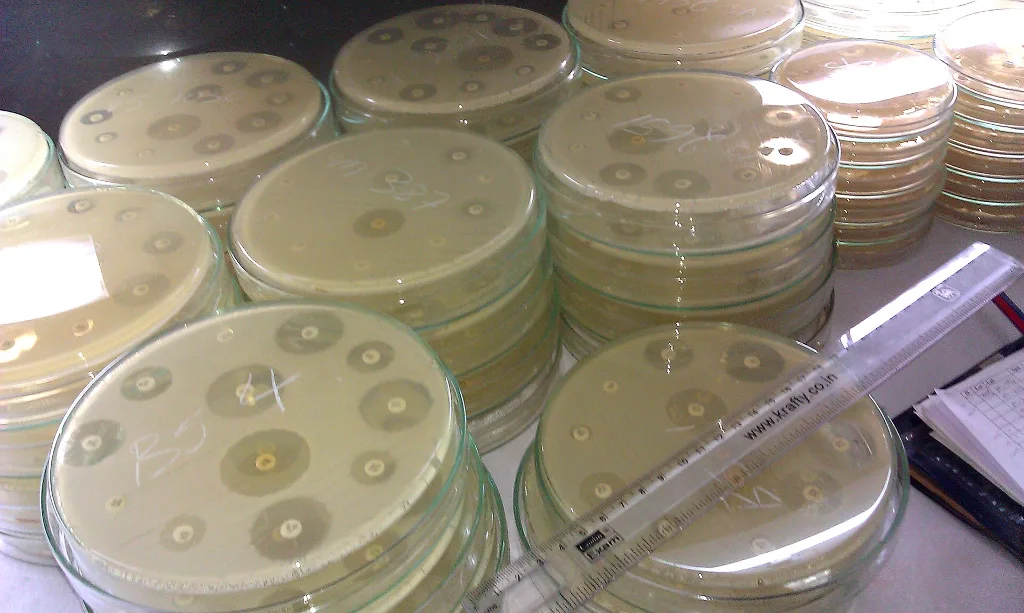
Photo: Antibiotic susceptibility testing by disk diffusion in a microbiology laboratory. Microrao, CC BY-SA 4.0, via Wikimedia Commons.