WHO to Nigeria: judge digital health by outcomes, not the number of platforms
WHO's representative in Nigeria says partners should invest through the national digital health architecture, not around it. What that means for hospitals choosing and running health IT.
In an interview published by Vanguard on 14 November 2026, Dr Pavel Ursu, the World Health Organization's Representative and Head of Mission in Nigeria, set out how WHO sees the country's digital health agenda. His central point: digital transformation in health "is not primarily about technology". It is about stronger, more equitable health systems, with technology as the enabler.
The problem: too many platforms that do not talk
Dr Ursu described a pattern familiar to anyone who has worked in a Nigerian hospital or state ministry: countries end up with multiple disconnected platforms, each funded by a different partner, that cannot communicate with each other. Data and digital transformation, he said, is one of the six pillars of WHO's cooperation with Nigeria for exactly this reason.
He named three priorities for Nigeria:
- Government ownership. Governance, standards, interoperability and digital architecture should be national public goods, owned and led by government.
- Outcomes over launches. Digital investments should be judged by their effect on service delivery and health outcomes, not by the number of platforms launched.
- Responsible AI. AI should be pursued responsibly, with data sovereignty protected and benefits reaching rural communities, women and people with limited digital access.
On AI specifically, he said it offers real opportunities to support health workers and improve decisions, but it should complement, not replace, professional judgement, and it depends on quality data, interoperability, cybersecurity, regulation and a well-trained workforce.
The national digital health architecture
The interview builds on an announcement made earlier in the year. As Premium Times reported on 2 October 2026, the Minister of State for Health and Social Welfare, Iziaq Salako, told the Africa Healthtech Summit in Kigali that Nigeria has developed a National Digital Health Architecture (NDHA), endorsed by the National Council on Health as the blueprint for a secure and interoperable ecosystem.
According to that report, the architecture is built around a Health Information Exchange with a Shared Health Record, and national registries for clients, health facilities and health workers, anchored on the principle of "one patient, one health record". The Minister said partners must strengthen national systems rather than create parallel ones. Dr Ursu put the same idea in WHO's words: partners, philanthropies and technology companies should invest through Nigeria's national digital health architecture, not around it.
The published reports do not yet set out technical standards, data protection rules or timelines for connecting facilities, so details for hospitals are still to come.
What this means for hospitals and clinics
For a hospital choosing or running an electronic health record, the direction is clear even before the details are published:
- Ask about interoperability, not just features. A system that keeps its data locked in will be harder to connect to a national exchange. Look for standard interfaces such as HL7 and FHIR and the ability to export records.
- Get identifiers and registries right now. Clean patient records, consistent facility details and an accurate staff register make it far easier to take part in national registries when they open.
- Measure outcomes. Turnaround times, missed follow-ups, billing leakage and reporting completeness are the measures that show whether a system is helping. A new screen is not the goal.
- Treat AI as decision support. AI tools should sit beside clinicians, explain their sources and leave the decision with a qualified person.
Syneom EHR is built on the same principles: one record per patient across the hospital, standard HL7 and FHIR interfaces, and decision support that advises but never decides. Talk to us about how your facility can prepare for a connected national system.
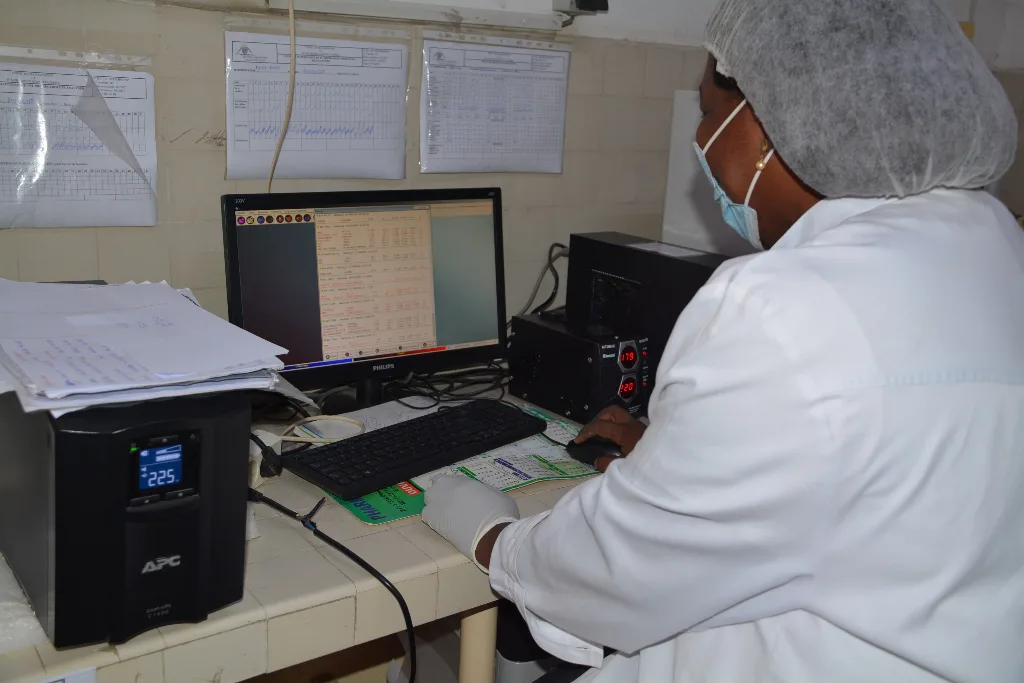
Photo: Entering results on a computer in a hospital laboratory in Douala, Cameroon. Happi Raphael, CC BY-SA 4.0, via Wikimedia Commons.