How WHO is using AI to read polio surveillance data across Africa
WHO's Africa GIS Centre has added AI to its polio dashboards, letting officers ask questions in plain language and get maps, tables and summaries. The tools speed up analysis, but WHO stresses they do not replace human verification.
The World Health Organization's Regional Office for Africa says artificial intelligence is now helping its polio programme make sense of surveillance data faster. In a release published on 18 November 2026, GIS Day, WHO described how AI has been built into the operational dashboards of its Geographic Information Systems (GIS) Centre.
What the tools do
Every week, the region's 47 countries send polio surveillance and operational data, including poliovirus detections, laboratory results, vaccination campaign coverage and records of health facility visits. WHO says the AI features let officers:
- Ask questions in plain language and receive maps, charts or tables from the dashboards. One example WHO gives is a breakdown, by district, of circulating variant poliovirus type 2 detections in a country since January 2026.
- Generate written summaries from current and archived records in the Poliovirus Detection Dashboard, supported by figures.
- Monitor vaccination campaigns, identifying delayed supplementary immunisation activities, the reasons reported for the delays and operational bottlenecks.
Dr Kebba Touray, Head of WHO Africa's GIS Centre, said "AI-supported analysis is enabling the program to strengthen the monitoring of poliovirus detections" and helping teams "identify potential surveillance gaps and identify areas with suboptimal campaign performance".
Faster analysis, same human judgement
WHO is clear about the limits: AI "does not replace epidemiological expertise or human verification". The benefit it describes is time. Less effort goes into extracting data and preparing reports by hand, and more into interpreting findings, checking information and following up on priority areas. WHO did not publish accuracy figures or measured time savings.
The lesson for health systems
The polio programme can use AI this way because it already has something many health programmes lack: consistent, structured data arriving from every country, every week, in a shared format. AI can only summarise what has been recorded. Three conditions made this possible, and they apply to any hospital or ministry considering AI:
- Clean, structured source data. Laboratory results, locations and dates captured as data, not as scanned forms.
- A defined question. The tools answer specific operational questions, such as where detections are rising and which campaigns are late, rather than producing open-ended advice.
- A person who checks the answer. Summaries are a starting point for an epidemiologist, not a final report.
The same approach is now reaching hospitals, where AI tools can draft summaries or flag patterns from patient records. The polio programme's experience suggests that the value lies less in the AI itself than in years of disciplined data collection, with human review kept in place.
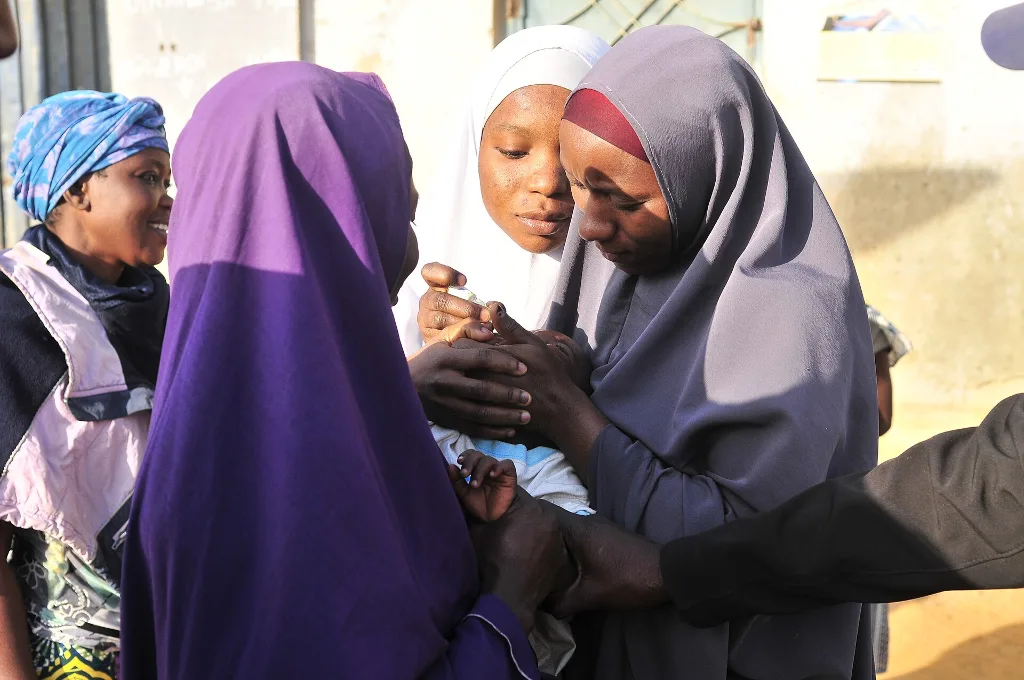
Photo: Female health workers vaccinate and mark a child during a polio campaign in Nigeria. Heather Scobie/CDC Global, CC BY 2.0, via Wikimedia Commons.