Kenya's last Ebola patient goes home: what the countdown to 23 December means
Kenya discharged its last Bundibugyo Ebola patient on 11 November and could be declared free of the disease on 23 December. Four of its nine cases were health workers infected before Ebola was suspected.
Kenya's last Ebola patient went home on 11 November 2026, and the country's final 11 contacts completed their monitoring the same day. For the first time since the outbreak began, Kenya has no patient in treatment and no contacts in quarantine, WHO reported.
"Forty-two days is twice the longest incubation period of the virus," said Health Cabinet Secretary Aden Duale. "If no new case is recorded in that period, Kenya will be declared free of Ebola on 23 December 2026."
The outbreak in numbers
- First case: confirmed on 6 October 2026, in a Kenyan who had travelled home from the Democratic Republic of the Congo through Uganda.
- Total: nine confirmed cases, of whom seven recovered and two died. The last case was confirmed on 19 October.
- Who was infected: four family members of the first patient, and four health workers who cared for him before Ebola was suspected.
- Contacts: 135 close contacts were identified in Kenya and abroad, and all of them were traced.
The disease is caused by Bundibugyo virus. According to WHO's Disease Outbreak News of 6 November, there is no approved vaccine or specific treatment for it. A Phase 2/3 vaccine trial began in the DRC on 23 October. The wider outbreak remains serious: as of 3 November the DRC had reported 10,668 confirmed cases and 5,198 deaths. Nigeria recorded one imported case in Abuja in October; the patient was evacuated to Switzerland for treatment.
"Four of our colleagues were infected in the line of duty"
Mr Duale's words point to the hardest lesson of the outbreak. Health workers were infected before anyone suspected Ebola, when the first patient looked like any other seriously ill traveller. The countdown is a time to strengthen the parts of the health system that protect them:
- Ask about travel at the front door. A registration or triage record that captures recent travel and contact with sick people turns a single question into a prompt for isolation and testing.
- Make standard precautions routine. Gloves, hand hygiene and safe handling of body fluids for every patient with fever protect staff before a diagnosis is made.
- Know who was in contact. When the record shows which staff, beds and rooms a patient passed through, contact lists can be drawn up in hours, not days.
- Get samples to the laboratory and results back quickly. Kenya tested at five designated laboratories, including two mobile laboratories on the Ugandan border.
"The countdown is not the end of our response," Mr Duale said. Rapid response teams stay on alert in every county, and survivors will receive follow-up care. Kenya has not restricted movement or gatherings, and WHO advises against travel and trade restrictions.
Anyone in Kenya with fever, weakness, muscle pain, vomiting, diarrhoea or unexplained bleeding is advised to seek care early and call 719.
Sources: WHO Kenya, 11 November 2026; WHO Disease Outbreak News DON625, 6 November 2026.
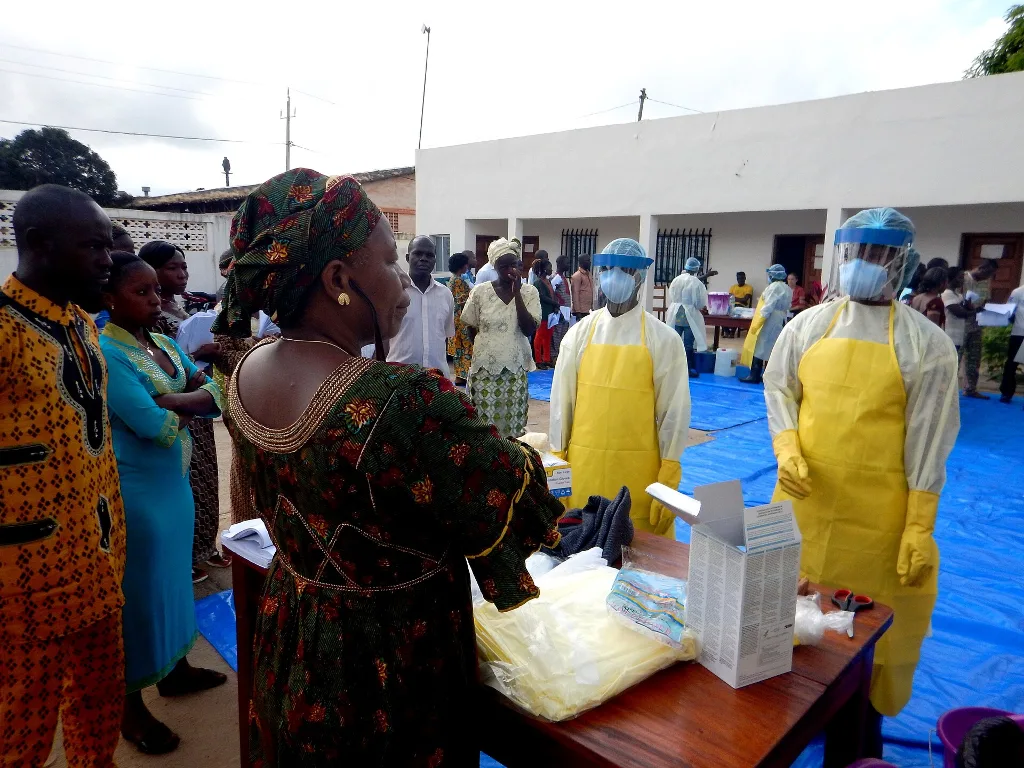
Photo: Frontline health workers in Guinea train in the safe use of personal protective equipment for suspected Ebola patients. CDC Global, CC BY 2.0, via Wikimedia Commons.